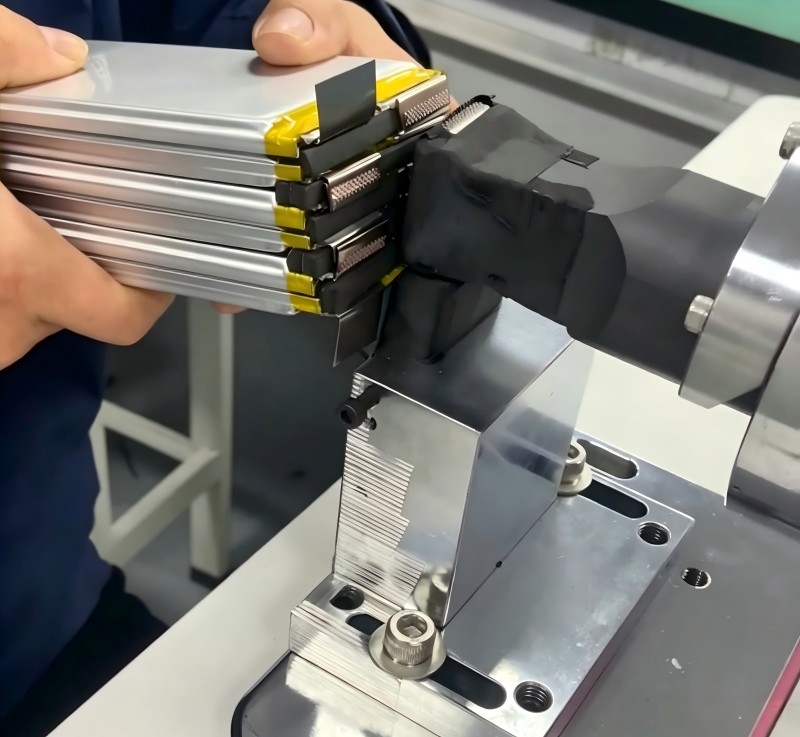
♻️Specification
| Model | JS-2040 |
| Ultrasonic Power | 4000 W |
| Frequency | 20 kHz |
| Voltage | 220 V |
| Size | 750 × 400 × 730 (rack size) |
| 380 × 350 × 150 mm(generator size) |
| Welding Materials | Copper / Aluminum / Nickel |
| Applicable Total Material Thickness | 0.1–1.2 mm |
| Machine Weight | 65 kg |
| Frequency Tracking | Automatic |
| Amplitude | Adjustable |
| Control Interface | Chinese / English |
| Welding Data | Recording & Traceability |
| Protection | Intelligent / Over-current Protection |
♻️Features
1. 4kW Ultrasonic Power
The 4000W ultrasonic system provides the power required for demanding metal welding applications involving copper, aluminum, nickel and multilayer conductive materials.
2. 20kHz Ultrasonic System
The 20kHz operating frequency is designed for industrial ultrasonic metal welding applications, with the welding tool transferring mechanical vibration directly to the joint area.
3. Digital Generator
The digital generator provides precise control of the ultrasonic welding process and supports parameter adjustment for different material combinations and welding requirements.
4. Automatic Frequency Tracking
The generator automatically tracks the operating frequency during welding to maintain the ultrasonic system in its working range.
5. Adjustable Amplitude
Ultrasonic amplitude can be adjusted according to the material, thickness and welding configuration.
This allows the welding process to be adapted to different copper, aluminum and nickel applications.
6. Time Mode & Tuning Mode
The system provides different operating modes for welding parameter adjustment and ultrasonic system tuning.
7. Intelligent Protection
The generator includes intelligent protection functions such as over-current protection to help protect the ultrasonic system during operation.
8. Welding Data Recording
Welding data can be recorded for process traceability and production management.
9. Bilingual Interface
The control interface supports Chinese and English, making the machine suitable for international production environments.
10. Precision Linear Guide
The mechanical structure uses a precision linear guide to provide controlled movement of the welding head.

♻️Materials & Welding Applications
Copper Welding
| copper foil
copper tabs
copper plates
copper conductive strips
coppwer wire/harness |
|
|
|
|
| Aluminum Welding | Aluminum foil Aluminum tabs Aluminum strips Aluminum conductive components |
| Nickel Welding | Nickel tabs Nickel strips Nickel-plated conductive components |
♻️How Ultrasonic Battery Welding Works
1. Material Positioning
The battery tab, foil or conductive components are positioned between the ultrasonic sonotrode and lower fixture.
2. Welding Pressure
The welding head applies controlled pressure to hold the materials together.
3. Ultrasonic Vibration
High-frequency ultrasonic vibration is transferred through the sonotrode to the welding area.
4. Interface Friction & Deformation
The ultrasonic vibration produces localized relative movement and plastic deformation at the metal interface.
5. Solid-State Joint
The metal components form a solid-state connection without conventional arc welding or additional filler material.
♻️Advantages of Ultrasonic Metal Welding
- Short ultrasonic welding cycle
- No solder or additional filler material
- No conventional arc or flame
- Suitable for conductive metal joining
- Low electrical resistance when the joint is properly developed
- Suitable for multilayer foil applications
- Localized process with limited thermal influence compared with conventional fusion welding
- Adjustable welding parameters
- Process data recording for traceability
- Suitable for copper, aluminum and nickel materials
♻️Sonotrode & Tooling-Battery Welding Sonotrode
The sonotrode directly transfers ultrasonic vibration to the welding area and plays an important role in the welding result.
For battery tab applications, the sonotrode geometry can be selected or customized according to:
- Battery tab dimensions
- Foil thickness
- Number of foil layers
- Welding area
- Material combination
- Required weld pattern
- Welding direction
The welding tool should be matched with the actual battery joint rather than selected only according to machine power.Custom ultrasonic sonotrodes and welding fixtures are available according to customer samples or drawings.
♻️Sample Testing-Welding Sample Testing
Battery welding performance depends on the actual combination of material, thickness, layer count, tab geometry and weld area.
For new applications, Qijiang recommends testing the customer's actual materials before final machine configuration.Send us your battery welding sample to evaluate the application.
Customers can provide | · Battery tabs |
· Copper or aluminum foil |
· Nickel strips |
· Multilayer foil samples |
· Product drawings |
· Required weld dimensions |
The welding test can then be used to evaluate:
|
- Mechanical joint strength
|
|
|
- Suitable welding parameters
|
|
♻️FAQ
Yes. The JS-2040 is designed for ultrasonic metal welding of aluminum and can be configured for aluminum tabs and foil applications according to the actual material and joint structure.
Can it weld copper foil?
Yes. Copper foil welding is one of the listed applications of the machine, including multilayer copper foil applications.
Can it weld copper and nickel?
The machine can be configured for selected copper/nickel welding applications. The actual welding result depends on material thickness, surface condition, weld area and tooling.
What is the maximum welding thickness?
The current specification lists an applicable total material thickness of 0.1–1.2 mm. The actual capability should be confirmed according to the material combination and welding configuration.
Can the machine weld multilayer battery foil?
Yes. Multilayer foil welding is one of the intended applications. The actual number of layers depends on individual foil thickness, total stack thickness, material and weld area.
Can you customize the welding horn?
Yes. The sonotrode and welding fixture can be designed according to the battery tab dimensions, welding area and product structure.
♻️Video
 Whatsapp