 Qijiang Precision Machinery
Service Center
 Whatsapp
Contacts
Contact
Lisa
Whatsapp
08615006191865
WeChat
08615006191865
Qrcode

Scan Whatsapp
Service Center


Qijiang
Precision Machinery

Technical Analysis of Dual-Process Sealing for PP Liquid Filter Bags Using Hot Air and Ultrasonic Welding
Time: 2025-08-14 09:36:55
Click:
Polypropylene (PP) liquid filter bags are widely used in liquid filtration for industries such as chemicals, food, coatings, and pharmaceuticals. To achieve high sealing performance and production efficiency, this article explores a dual-process approach combining hot air welding for the bag body and ultrasonic sealing for the bottom. The structural advantages, performance improvements, and production adaptability of this method are analyzed in detail.

Liquid filter bags demand high welding quality, requiring both strong and leak-proof seams while maintaining production speed and consistency. Traditional sewing or adhesive bonding methods are prone to leakage, uneven seams, and insufficient chemical resistance. The combination of hot air welding and ultrasonic welding provides a new solution to these challenges.
Hot Air Welding for Bag Body – Principle and Advantages

①A hot air welding machine uses heated, high-speed airflow to soften the PP material’s joint surfaces, which are then fused under mechanical pressure.
- Uniform and Smooth Seams – Minimizes wrinkles and ensures stable filtration flow channels.
- Adjustable Parameters – Temperature, airflow, and feed rate can be precisely set according to material thickness.
- Material Compatibility – Suitable for PP nonwoven fabric, monofilament mesh, and composite fabrics.

(Hot air welding for Filter bag body )
②Ultrasonic Sealing for Bag Bottom
Ultrasonic welding applies high-frequency vibrations to generate localized heat via molecular friction, melting the contact surfaces to achieve a seamless seal.
- Fast Solidification – Typical welding time is less than 0.5 seconds, ensuring high efficiency.
- No Consumables – Eliminates the need for glue or sewing threads, avoiding chemical contamination.
- High Resistance – Dense sealing structure with strong tolerance to acids, alkalis, and high temperatures.

(Ultrasonic sealing of filter bag bottom)
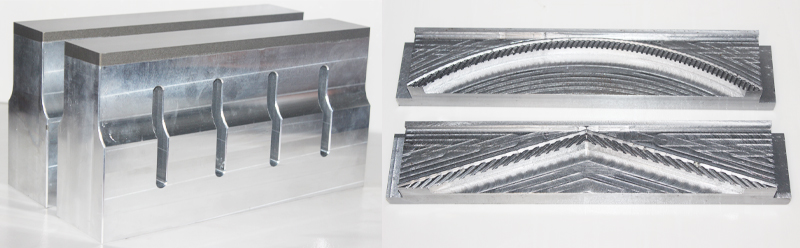
(Welding mold )
Technical Value of the Dual-Process Combination
- Enhanced Sealing Performance – The bag body and bottom are optimized with different welding techniques to eliminate leakage risks.Filter bag body heat welding machine
- Optimized Production Cycle – Hot air welding and ultrasonic sealing can operate in sequence on the same production line.
- Quality Control – Both processes allow parameterized settings, enabling consistent quality in mass production.

Applications and Future Development
This dual-process method is suitable for large-scale PP liquid filter bag manufacturing and can be extended to materials like PE and nylon. In the future, the integration of automated inspection and data feedback could enable real-time monitoring and intelligent adjustment of welding quality, further improving production efficiency and product reliability.

The combination of hot air welding and ultrasonic sealing offers an efficient and reliable sealing solution for PP liquid filter bags. It delivers excellent sealing strength, durability, and production efficiency, meeting modern industrial demands for high-performance, low-consumable manufacturing. With advancements in automation, this process could become the new standard in liquid filtration consumable production.


Products
CONTACT US
Sales manager: Lisa
Whatsapp/wechat:+08615006191865
Email:qjmachinery@gmail.com
COPYRIGHT © 2025 Wuxi Qijiang Precision Machinery Co., Ltd all rights reserved
